Micronaut Serialization can be used to replace the use of Jackson Databind in a Micronaut application and allows serialization on top of a number of different encoding runtimes including Jackson Core, JSON-P, BSON, CBOR, or YAML.
1.1 Why Micronaut Serialization?
The goal of this project is to be an almost complete build-time replacement for Jackson Databind, that does not rely on reflection and has a smaller runtime footprint. The reasons to provide an alternative to Jackson are outlined below.
Memory Performance
Micronaut Serialization consumes less memory and has a much smaller runtime component. As a way of comparison Micronaut Serialization is a 380kb JAR file, compared to Jackson Databind which is well over 2mb. This results in a reduction of 5MB in terms of image size for native image builds.
The elimination of reflection and smaller footprint also results in reduced runtime memory consumption.
Runtime Performance
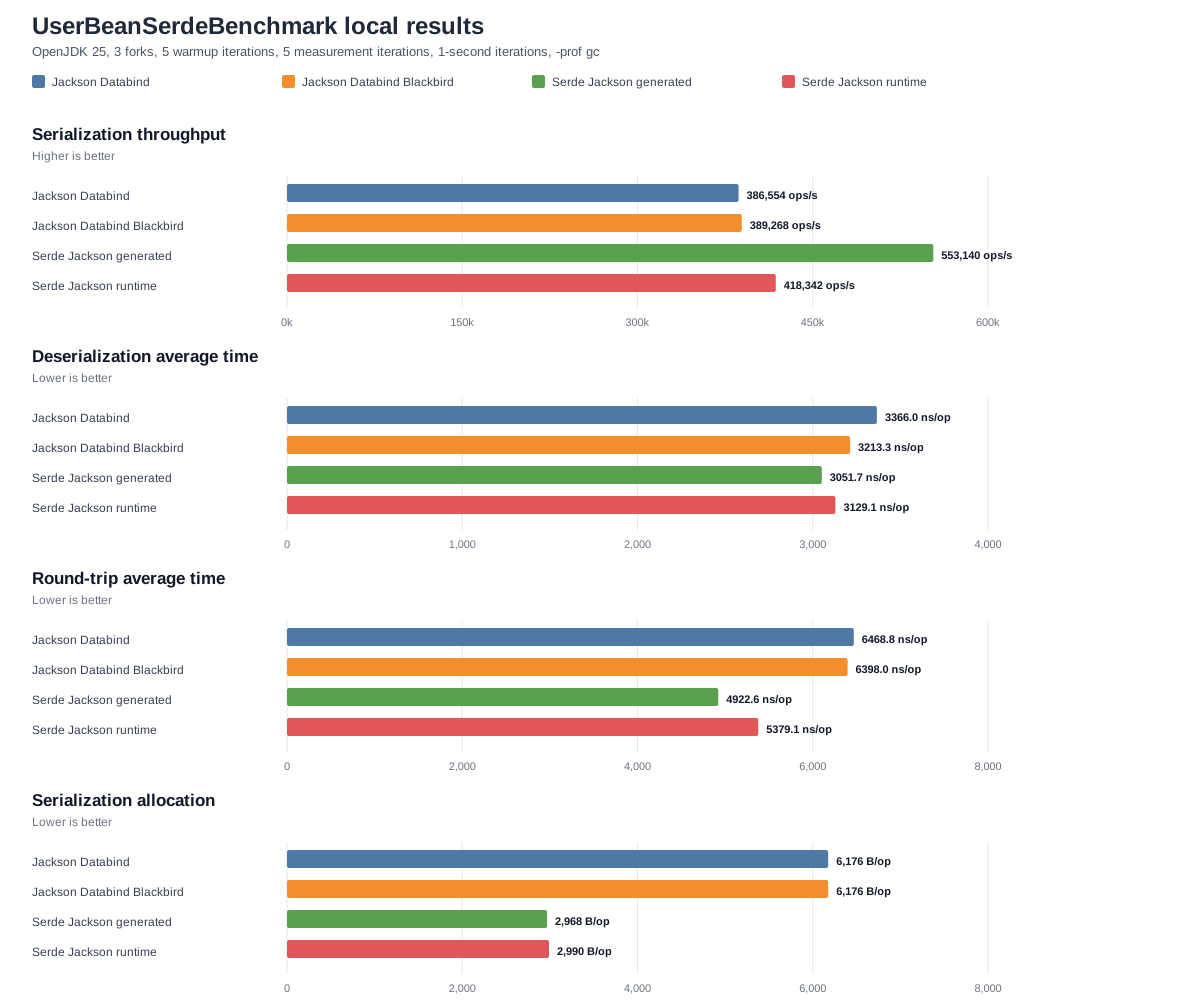
The UserBeanSerdeBenchmark JMH benchmark compares Jackson Databind, Jackson Databind with Blackbird, Micronaut Serialization using generated serializers/deserializers, and Micronaut Serialization with generated serializers/deserializers disabled. A full local UserBeanSerdeBenchmark run on OpenJDK 25 used 3 forks, 5 warmup iterations, and 5 measurement iterations with 1-second iterations and -prof gc.
Operation
Jackson Databind
Jackson Databind Blackbird
Micronaut Serialization generated
Micronaut Serialization runtime
Serialize throughput
386,554 ops/s
389,268 ops/s
553,140 ops/s
418,342 ops/s
Deserialize average time
3,366 ns/op
3,213 ns/op
3,052 ns/op
3,129 ns/op
Round-trip average time
6,469 ns/op
6,398 ns/op
4,923 ns/op
5,379 ns/op
Serialize allocation
6,176 B/op
6,176 B/op
2,968 B/op
2,990 B/op
In this run, generated Micronaut Serialization had the highest serialization throughput, about 43.1% faster than Jackson Databind and about 32.2% faster than the runtime fallback, while also allocating less than half as many bytes per serialized payload. It was also the fastest deserialization path, about 9.3% faster than Jackson Databind and about 2.5% faster than the runtime fallback, and the fastest combined serialize-and-deserialize round trip, about 23.9% faster than Jackson Databind and about 8.5% faster than the runtime fallback. The runtime fallback remained slower than generated Micronaut Serialization across all measured operations, which is expected because it uses runtime serializer/deserializer selection instead of generated classes.
Security
Unlike Jackson, you cannot serialize or deserialize arbitrary objects to JSON. Allowing arbitrary serialization is often a source of security issues in modern applications. Instead with Micronaut Serialization to allow a type to be serialized or deserialized you must do one of the following:
Declare the @Serdeable annotation at the type level in your source code to allow the type to be serialized or deserialized.
If you cannot modify the source code and the type is an external type you can use @SerdeImport to import the type. Note that with this approach only public members are considered.
Define a bean of type Serializer for serialization and/or a bean of type Deserializer for deserialization.
Type Safety
Jackson provides an annotation-based programming model that includes many rules developers need to be aware of and can lead to runtime exceptions if these rules are violated.
Micronaut Serialization adds compile-time checking for correctness when using JSON binding annotations.
Runtime Portability
Micronaut Serialization decouples the runtime from the actual source code level annotation model whilst Jackson is coupled to Jackson annotations. This means you can use the same runtime, but choose whether to use Jackson annotations, JSON-B annotations or BSON annotations
This leads to less memory consumption since there is no need to have multiple JSON parsers and reflection-based meta-models if you using both JSON in your webtier plus a document database like MongoDB.
2 Release History
For this project, you can find a list of releases (with release notes) here:
For Kotlin, add the micronaut-serde-processor dependency in kapt or ksp scope, for Groovy add micronaut-serde-processor in compileOnly scope, and for Python add it to the build dependencies of pyproject.toml as shown above.
You should then choose a combination of Annotation-based programming model and runtime implementation that you desire.
3.1 Jackson Annotations & Jackson Core
To replace Jackson Databind, but continue using Jackson Annotations as a programming model and Jackson Core as a runtime replace the micronaut-jackson-databind module in your application with micronaut-serde-jackson.
Add the following artifact to the dependencies block:
With the correct dependencies in place you can now define an object to be serialized:
Note
The third callout has no Python counterpart: the @dataclass generates the creator, so there is nothing to annotate with @JsonCreator.
Tip
If you don’t want to add a Micronaut Serialization annotation then you can also add a type-level Jackson annotation like @JsonClassDescription, @JsonRootName or @JsonTypeName
Once you have a type that can be serialized and deserialized you can use the ObjectMapper interface to do so:
@MicronautTestclass BookTest { @Test fun testWriteReadBook(objectMapper: ObjectMapper) { val result = objectMapper.writeValueAsString(Book("The Stand", 50)) val book = objectMapper.readValue(result, Book::class.java) assertNotNull(book) assertEquals( "The Stand", book!!.title ) assertEquals(50, book.quantity) }}
@MicronautTestclass BookTest extends Specification { @Inject ObjectMapper objectMapper void "test read/write book"() { when: String result = objectMapper.writeValueAsString(new Book("The Stand", 50)) Book book = objectMapper.readValue(result, Book) then: book != null book.title == "The Stand" book.quantity == 50 }}
3.2 JSON-B Annotations & JSON-P
To completely remove all dependencies on Jackson Databind and use JSON-B annotations in your source code combined with JSON-P at runtime, replace micronaut-jackson-databind with Micronaut Serialization.
Micronaut Serialization provides three Jakarta JSON artifacts with different purposes:
micronaut-serde-jsonp is the existing JSON-P stream integration backed by Eclipse Parsson.
micronaut-serde-jsonp-impl is the Micronaut-native JSON-P provider. It implements jakarta.json.spi.JsonProvider without depending on Parsson and does not use reflection.
micronaut-serde-jsonb is the Micronaut Serialization backed JSON-B runtime provider. It implements jakarta.json.bind.spi.JsonbProvider; JSON-B compatibility behavior may use reflection only as an isolated fallback when Micronaut introspection and serialization metadata cannot satisfy a spec-required runtime type.
Add the following artifact to the dependencies block:
@MicronautTestclass BookTest { @Test fun testWriteReadBook(objectMapper: ObjectMapper) { val result = objectMapper.writeValueAsString(Book("The Stand", 50)) val book = objectMapper.readValue(result, Book::class.java) assertNotNull(book) assertEquals( "The Stand", book!!.title ) assertEquals(50, book.quantity) }}
@MicronautTestclass BookTest extends Specification { @Inject ObjectMapper objectMapper void "test read/write book"() { when: String result = objectMapper.writeValueAsString(new Book("The Stand", 50)) Book book = objectMapper.readValue(result, Book) then: book != null book.title == "The Stand" book.quantity == 50 }}
3.3 BSON Annotations and BSON
To completely remove all dependencies on Jackson and use BSON annotations in your source code combined with BSON at a runtime you should replace the micronaut-jackson-databind and micronaut-jackson-core modules in your application with micronaut-serde-bson.
Add the following artifact to the dependencies block:
@MicronautTestclass BookTest { @Test fun testWriteReadBook(objectMapper: ObjectMapper) { val result = objectMapper.writeValueAsString(Book("The Stand", 50)) val book = objectMapper.readValue(result, Book::class.java) assertNotNull(book) assertEquals( "The Stand", book!!.title ) assertEquals(50, book.quantity) }}
micronaut-serde-jackson-cbor uses Jackson’s streaming CBOR factory (jackson-dataformat-cbor) only as a token parser/generator. Object mapping is performed by Micronaut Serialization’s build-time serializers and deserializers. Jackson Databind is not used (the dataformat module’s transitive databind dependency is excluded).
Tip
Adding this module also brings micronaut-serde-jackson for the shared streaming encoder/decoder bridge. When both are present, Jackson remains the primary JSON JsonMapper. Inject CborObjectMapper for CBOR. JSON-only applications that do not depend on micronaut-serde-jackson-cbor never load CBOR beans.
With the dependency in place you can define an object to be serialized:
@MicronautTestpublic class BookTest { @Test void testWriteReadBook(CborObjectMapper cborObjectMapper) throws IOException { byte[] bytes = cborObjectMapper.writeValueAsBytes(new Book("The Stand", 50)); assertNotNull(bytes); assertTrue(bytes.length > 0); // CBOR map major type, not JSON text assertTrue((bytes[0] & 0xE0) == 0xA0); Book book = cborObjectMapper.readValue(bytes, Book.class); assertNotNull(book); assertEquals("The Stand", book.getTitle()); assertEquals(50, book.getQuantity()); }}
imports
from typing import Annotatedfrom jakarta.inject import Injectfrom micronaut.serde.cbor import CborObjectMapperfrom micronaut.test.extensions.junit5.annotation import MicronautTestfrom org.junit.jupiter.api import Testfrom example.Book import Book
@MicronautTestclass BookTest: cbor_object_mapper: Annotated[CborObjectMapper, Inject] @Test def test_write_read_book(self): data = self.cbor_object_mapper.writeValueAsBytes(Book("The Stand", 50)) assert data is not None assert len(data) > 0 # CBOR map major type, not JSON text assert (data[0] & 0xE0) == 0xA0 book = self.cbor_object_mapper.readValue(data, Book) assert book is not None assert book.title == "The Stand" assert book.quantity == 50
@MicronautTestclass BookTest extends Specification { @Inject CborObjectMapper cborObjectMapper void "test read/write book"() { when: byte[] bytes = cborObjectMapper.writeValueAsBytes(new Book("The Stand", 50)) then: bytes != null bytes.length > 0 // CBOR map major type, not JSON text (bytes[0] & 0xE0) == 0xA0 when: Book book = cborObjectMapper.readValue(bytes, Book) then: book != null book.title == "The Stand" book.quantity == 50 }}
Coexistence with JSON
Need
Inject / use
Default JSON
JsonMapper / ObjectMapper (primary = Jackson when present)
CBOR
CborObjectMapper or HTTP media type application/cbor
Both formats share the same @Serdeable types and generated serializers.
Binary data
For CBOR, byte[] defaults to native byte strings (RFC 8949 major type 2), not the global JSON-legacy numeric-array encoding. This is controlled by micronaut.serde.cbor.write-binary-as-array (default false) and does not change JSON behaviour.
@Controller("/books")public class BookController { @Post(processes = CborMediaTypes.APPLICATION_CBOR) public Book save(@Body Book book) { return book; }}
imports
from typing import Annotatedfrom micronaut.http.annotation import Body, Controller, Postfrom micronaut.serde.cbor import CborMediaTypesfrom example.Book import Book
@Controller("/books")class BookController { @Post(processes = CborMediaTypes.APPLICATION_CBOR) Book save(@Body Book book) { return book }}
The constant CborMediaTypes#APPLICATION_CBOR is provided for convenience. When Micronaut Core adds MediaType.APPLICATION_CBOR, that constant will remain a stable alias for the same media type string (application/cbor).
Security and limits
CBOR parsing and writing honour micronaut.serde.maximum-nesting-depth (and related stream limits) to bound stack usage on nested structures. Prefer keeping limits enabled for untrusted input. Very large byte strings are limited by available heap; apply HTTP body size limits at the server as usual.
Streaming factory features
Optional CBOR and stream features map to Jackson’s streaming configuration:
These control token encoding details (for example minimal integer width). They do not implement full canonical/deterministic CBOR (sorted map keys, etc.).
Limitations and roadmap
Map keys are text strings (integer map keys are not supported without Serde SPI changes).
CBOR tags (date/time, bigfloats, etc.) are not applied; temporals use existing Micronaut Serde encodings.
Indefinite-length encoding follows the streaming library defaults.
Full deterministic/canonical CBOR is not a built-in mode.
Reactive parsing (createReactiveParser) buffers before parsing and splits chunks with a JSON-oriented lexer, so it is only reliable when each byte[] chunk is a complete CBOR value. Use the byte-array or stream APIs for chunked input.
byte[] read into a JsonNode tree or an untyped Object becomes a base64 string in the tree (the tree representation Micronaut Serde uses for binary) and a byte[] in the untyped case.
3.5 YAML
Micronaut Serialization includes support for reading and writing YAML documents with the micronaut-serde-yaml module.
Add the following artifact to the dependencies block:
micronaut-serde-yaml uses the event based parser and emitter of snakeyaml-engine only as a token source and sink. Object mapping is performed by Micronaut Serialization’s build-time serializers and deserializers, and neither SnakeYAML’s object construction nor Jackson Databind is involved.
The YAML mapper is exposed as a named ObjectMapper bean. Inject it with the yaml qualifier, or by its concrete type YamlObjectMapper, when you want to read or write YAML data. When micronaut-serde-jackson is also present, Jackson remains the primary JSON mapper:
A document may have a mapping, a sequence or a scalar as its root node, so a List<Book> reads from a top-level sequence and a String from a bare scalar. Exactly one document is read: an explicit --- start marker and … end marker are accepted, but a second document in the same input is rejected. Empty input is rejected as well.
Plain scalars are typed with the YAML 1.2 core schema. Quoted scalars are always strings, integers may be written in decimal, octal (0o17) or hexadecimal (0x1F) notation, and .inf, -.inf and .nan are read as the non-finite floating-point values. Numbers that do not fit a long or a double keep their precision when read into a BigInteger or BigDecimal. Mapping keys must be scalars; complex keys written with the ? indicator are rejected.
Anchors, aliases and merge keys are resolved while reading:
An alias replays the anchored node, including any aliases or merges that were resolved inside it. A merge key << splices the entries of the referenced mapping, or of each mapping in a referenced sequence, into the enclosing mapping. A key the mapping defines itself always wins over a merged key, wherever in the mapping it is written, and a mapping earlier in a merged sequence wins over the ones after it, as the merge key specification requires. Unknown properties, including nested mappings and sequences, are skipped like they are for JSON.
Note
Because the keys a mapping defines are only all known once the mapping ends, merged entries are read at the end of the enclosing mapping. That is invisible for beans and records, and only changes the iteration order of a Map read from a mapping that uses a merge key. Jackson Databind instead lets a merged key override a key written before the merge key; Micronaut Serialization follows the specification here.
Read Features
YAML read behavior is configured under micronaut.serde.format.yaml.read-features:
When enabled, legacy YAML boolean-like values such as yes, no, on, and off are read as strings. The canonical true and false values remain booleans. Disable it to interpret the legacy values as booleans.
empty-string-as-null
When enabled, an empty plain scalar such as key: is read as null. Disable it to read the value as an empty string. Quoted empty strings remain strings.
code-point-limit
The maximum number of characters a single YAML input may contain. Larger input is rejected before it is parsed, which bounds the memory an untrusted document can claim. The default is 3 MiB. The nesting depth of documents is bounded by micronaut.serde.maximum-nesting-depth like it is for the other formats. Alias expansion is capped as well, per alias and for the document as a whole, so that recursive documents, exponentially expanding ones and documents that simply repeat an alias to a large anchored node fail instead of consuming memory.
Write Features
YAML write behavior is configured under micronaut.serde.format.yaml.write-features. All available settings can be configured together as follows; normally, only settings that differ from their defaults need to be specified:
Selects BLOCK or FLOW collection output. For example, flow style writes a mapping containing a sequence as {values: [A, B]}.
indent
Controls the number of spaces used for each nested mapping level. The default is two.
explicit-start and explicit-end
Add the YAML document markers --- and …, respectively:
---key: value...
canonical-output
Forces canonical YAML output. Collections use explicit flow syntax, scalars are quoted, mapping keys use ?, and the document starts with ---:
---{ ? "key" : "value",}
indent-arrays
Adds one space before block sequence indicators:
values:
 - A
 - B
indent-arrays-with-indicator
Indents sequence indicators by two spaces and includes that offset when aligning nested sequence content. When both array indentation features are enabled, this setting takes precedence:
values:
  - A
  - B
allow-long-keys
Raises the simple-key limit from 128 to 1024 characters. Without it, longer keys are written with YAML’s explicit ? key syntax; with it, eligible long keys remain in key: value form.
Scalar Formatting
minimize-quotes
Omits quotes from strings when YAML permits. Strings that would otherwise be read back as another type, such as true, null or 123, and strings containing YAML indicators stay quoted. Disable it to write strings such as hello world as "hello world". Multiline strings are written in literal block style while quotes are minimized.
literal-block-style
Writes multiline strings in YAML literal block style even when minimize-quotes is disabled:
text: |-
  Hello
  World
split-lines
Allows long double-quoted strings to wrap across lines. Disable it when quoted strings must remain on one output line.
use-yaml-nonfinite-notation
Writes non-finite floating-point values as .nan, .inf, and -.inf. Disable it to use NaN, Infinity, and -Infinity for compatibility with Java-oriented consumers.
Documents are always written with \n line breaks so the output is identical on every platform.
HTTP
The module registers a message body handler for application/yaml (RFC 9512) and the legacy application/x-yaml media type, so controllers and clients can consume and produce YAML bodies:
@Controllerpublic class YamlBookController { @Post(uri = "/books", processes = YamlMediaTypes.APPLICATION_YAML) public Book save(@Body Book book) { return book; }}
imports
from typing import Annotatedfrom micronaut.http.annotation import Body, Controller, Postfrom micronaut.serde.yaml import YamlMediaTypesfrom example.Book import Book
@Controllerclass YamlBookController { @Post(uri = "/books", processes = YamlMediaTypes.APPLICATION_YAML) Book save(@Body Book book) { return book }}
The constants YamlMediaTypes#APPLICATION_YAML and YamlMediaTypes#APPLICATION_X_YAML are provided for convenience. JSON stays the default for content negotiation; YAML is selected by the request Content-Type and Accept headers.
Limitations
Only one document per input is supported.
Mapping keys must be scalars.
Explicit YAML tags are honoured for the core schema types (!!str, !!int, !!float, !!bool, !!null); other tags are read as strings and no tags are written.
Anchors and aliases are not written. Repeated object references are serialized as copies, and the Jackson USE_NATIVE_OBJECT_ID and USE_NATIVE_TYPE_ID features have no equivalent.
3.6 TOON
Micronaut Serialization includes support for reading and writing TOON (Token-Oriented Object Notation) documents with the micronaut-serde-toon module.
Add the following artifact to the dependencies block:
The TOON mapper is tree-based: it reads the whole document into a JsonNode before deserializing, unlike the streaming YAML and JSON mappers.
The TOON mapper is exposed as a named ObjectMapper bean. Inject it with the toon qualifier, or by its concrete type ToonMapper, when you want to read or write TOON data:
class ToonQuickStartTest { @Test void testWriteAndReadToon() throws IOException { try (ApplicationContext context = ApplicationContext.run()) { ObjectMapper toonMapper = context.getBean(ToonMapper.class); ToonLibrary library = new ToonLibrary("City Library", List.of( new ToonBook("The Stand", List.of("Stephen King")), new ToonBook("VALIS", List.of("Philip K. Dick")) )); String toon = new String(toonMapper.writeValueAsBytes(library)); assertEquals(""" name: City Library books[2]: - title: The Stand authors[1]: Stephen King - title: VALIS authors[1]: Philip K. Dick""", toon); assertEquals(library, toonMapper.readValue(toon, ToonLibrary.class)); } }}
Tabular Representation
Uniform collections and maps are serialized using TOON’s tabular representations, minimizing token overhead:
Keyed tabular objects are also supported for uniform map structures:
users[2:]{age,role}:
  alice: 30,admin
  bob: 25,user
Interoperability
The TCK checks, in both directions, that documents are exchanged with the JToon (dev.toonformat:jtoon) 2.0.4 library for: tabular arrays, keyed tabular objects ([N:]{…}), nested field groups ({a{b,c}}), numbers in scientific notation (below 1e-6 or from 1e21), and # comment lines on input. No compatibility option is needed for these shapes. The mapper and JToon also agree on every TOON specification encode and decode fixture that applies to the mapper, on string and key quoting for each delimiter, and on decoding of the common document edge cases. They differ in these ways:
A BigInteger outside the long range is written as a quoted decimal string, the same as JToon. JToon reads such a value back as a string; the mapper reads an unquoted integer beyond the long range as a BigInteger or BigDecimal, while JToon reads it as a string or a double.
JToon 2.0.4 accepts length markers ([#3]) and whitespace between a field name and its nested field group ({x {y}}). The mapper rejects both, as the specification does.
Other TOON implementations may not support all of them, depending on the specification version they target.
Configuration
TOON formatting is configured under micronaut.serde.format.toon:
Selects the delimiter for array and tabular rows. Supported options are COMMA (default), TAB, and PIPE.
indent
Number of spaces per indentation level when writing. The default is 2.
max-input-size
Maximum number of bytes of TOON input read when decoding. Larger input is rejected with a SerdeException. By default there is no limit.
Decoding Leniency
Decoding is more lenient than the TOON specification’s strict mode in two ways:
Indentation is not checked against the configured indent, which only affects encoding. The decoder infers the indent step from the first nesting transition in the document and requires every later transition to use the same step. A document indented with 4 spaces throughout is accepted when indent is 2.
Blank lines are rejected only between two rows, entries or items of a declared-count array body, or between a list item’s continuation fields. Blank lines elsewhere are skipped.
Declared array lengths and field-list widths are still checked exactly.
Security and Limits
TOON parsing respects micronaut.serde.maximum-nesting-depth to guard against stack exhaustion from maliciously deep input structures.
The decoder reads the whole input into memory and builds a complete JsonNode tree before deserializing, and the encoder builds a tree before writing. Memory use therefore grows with document size. Set micronaut.serde.format.toon.max-input-size to reject input above a given number of bytes; this is recommended when decoding untrusted input such as LLM output or request bodies.
3.7 TOML
TOML serialization support is provided by the Micronaut TOML project through the micronaut-toml-serde module.
The *.properties mapper is exposed as a named ObjectMapper bean. Inject it with the properties qualifier when you want to read or write *.properties data:
Java *.properties documents require keys. Root objects can be written as properties, but root arrays and root scalar values cannot be written directly.
3.9 XML
To serialize and deserialize XML with Micronaut Serialization, choose either the JDK StAX runtime or the Woodstox runtime. Both provide a named XML ObjectMapper bean and use the same compile-time serialization metadata as the JSON, JSON-P, and BSON runtimes.
For the StAX implementation included with the JDK, add the following artifact to the dependencies block:
For Woodstox, use the following artifact instead. It includes the StAX integration transitively and selects Woodstox as the XML input and output factory implementation:
If your source code uses Jackson XML annotations such as @JacksonXmlProperty or @JacksonXmlElementWrapper, keep the Jackson XML annotation types on the compile classpath. Micronaut Serialization maps those annotations at compilation time; XML serialization still goes through Micronaut Serialization’s named XML mapper rather than a Jackson Databind XmlMapper.
Jakarta XML Binding annotations
Micronaut Serialization also recognizes the common Jakarta XML Binding 4 annotations at compile time. Add the annotation API to the compile classpath only; no JAXB runtime or JAXBContext is required:
@XmlRootElement, @XmlType, @XmlAccessorOrder, @XmlAccessorType, and @XmlEnum automatically make a type serdeable. Property-only JAXB annotations require the containing type to be explicitly serdeable or to have one of those class-level annotations. The Supported members column is exhaustive; unlisted members are ignored.
Annotation
Supported members
XML behavior
@XmlRootElement
name, namespace
Makes the type serdeable and sets the document root name and namespace. The default name is derived by decapitalizing the class name; default namespace does not add an explicit namespace.
@XmlElement
name, namespace, defaultValue, nillable, type
Changes the property element name and namespace. Collections and arrays use inline repeated elements by default. defaultValue applies only when an element is present but empty; missing, whitespace-only, and xsi:nil elements retain their normal behavior. nillable = true writes null elements and collection entries as xsi:nil="true"; false omits them. type selects a compatible scalar or collection-item serde through shared serde type metadata. required is ignored.
@XmlAttribute
name, namespace
Writes and reads the property as an attribute, using the configured name and namespace. Attributes are ordered before child elements. required is ignored.
@XmlElementWrapper
name, namespace, nillable
Wraps a collection or array in an XML element. Combine it with @XmlElement to set the item name and namespace. nillable = true writes a null collection as an xsi:nil="true" wrapper; false omits it. Empty non-null collections write an empty wrapper. required is ignored.
@XmlElements
value (@XmlElement choices: name, type)
Declares unwrapped polymorphic element choices. The element name selects the declared subtype during deserialization and the runtime subtype selects its element during serialization. Each choice’s namespace and required members are ignored.
@XmlElementRef
name, type
Declares one unwrapped polymorphic element reference. The name and type select the XML element and subtype. namespace and required are ignored. JAXBElement references are not supported.
@XmlElementRefs
value (@XmlElementRef choices: name, type)
Declares multiple unwrapped polymorphic element references. Each choice behaves as @XmlElementRef; namespace and required are ignored.
@XmlSeeAlso
value
Registers the listed subtypes for serde processing and subtype resolution. It does not add an XML type discriminator; combine it with @XmlElements, @XmlElementRef, or @XmlElementRefs when the element name selects a subtype.
@XmlValue
None
Writes the property as direct text content of its owning element. At most one value property is supported.
@XmlTransient
None
Ignores the annotated field or property. On a type, it prevents JAXB auto-binding unless a Micronaut or Jackson annotation explicitly binds the type.
@XmlType
propOrder
Makes the type serdeable and applies a non-default property order. name, namespace, factoryClass, and factoryMethod are ignored.
@XmlAccessorOrder
value = ALPHABETICAL
Makes the type serdeable and orders properties alphabetically. UNDEFINED leaves normal property ordering in effect.
@XmlAccessorType
value
Makes the type serdeable and selects field or property introspection. FIELD includes all fields, PROPERTY and PUBLIC_MEMBER use public JavaBean properties, and NONE includes only JAXB-annotated members.
@XmlID
None
Marks a String property as the identity used by @XmlIDREF references. The ID keeps its normal element or attribute representation.
@XmlIDREF
None
Writes an object reference as the target’s @XmlID string. Deserialization of object references, forward references, and collections of references is not supported.
@XmlEnum
None
Makes the enum serdeable. value (the schema base type) is ignored.
@XmlEnumValue
value
Sets the serialized and deserialized lexical value for the enum constant.
Names, transient properties, ordering, enum lexical values, and type overrides use shared serde metadata and can therefore affect other format implementations. JAXB defaults and nil policies are XML-only. Explicit Micronaut or Jackson configuration wins when it conflicts with JAXB metadata. Unsupported JAXB features include package @XmlSchema, adapters, JAXBElement, schema generation, and JAXBContext; unsupported annotation members include all required flags, @XmlType.name, @XmlType.namespace, @XmlType.factoryClass, @XmlType.factoryMethod, and @XmlEnum.value.
Note
The Jakarta XML Binding annotations are supported for Java, Kotlin and Groovy types. There is no Python example for them: a @XmlElement(defaultValue = "…") property written as a nil element reads back as None rather than the declared default, so use the Jackson XML annotations shown below from Python.
With the correct dependencies in place you can define an XML-serializable type:
Supported XML Annotations
Micronaut Serialization supports every annotation in the tools.jackson.dataformat.xml.annotation package. The standard Jackson @JsonRootName and @JsonProperty annotations also supply names and namespaces used by the XML mapper. The supported XML-specific members are described below.
Annotation
Supported members
XML behavior
@JacksonXmlProperty
isAttribute, localName, namespace
By default, the property is an XML element. Set isAttribute = true to write and read it as an attribute. localName changes the element or attribute name, and namespace supplies its namespace URI.
@JacksonXmlElementWrapper
useWrapping, localName, namespace
Controls the container element for an array or collection. Wrapping is enabled by default and uses the property name when localName is empty. Set useWrapping = false to write entries directly under the parent; localName and namespace configure the wrapper when wrapping is enabled.
@JacksonXmlRootElement
localName, namespace
Changes the document root element name and namespace. It affects only the root value. This annotation is deprecated in Jackson 3; prefer @JsonRootName unless the XML root must differ from other formats.
@JacksonXmlText
value
With value = true (the default), writes and reads the property as direct text inside its owning element. Attributes may be present on that element. Set value = false to retain normal property-element handling.
@JacksonXmlCData
value
With value = true (the default), writes String properties and String collection entries as CDATA. It can be combined with @JacksonXmlText for direct CDATA content. Deserialization accepts both CDATA and ordinary character data. Set value = false to use normal escaped text.
@JsonRootName
value, namespace
value changes the document root element name and namespace supplies its namespace URI.
@JsonProperty
value, namespace
For XML, value changes the property element or attribute name and namespace supplies its namespace URI. It can be combined with @JacksonXmlProperty(isAttribute = true) to create a named, namespaced attribute. Other @JsonProperty behavior is shared with the non-XML runtimes.
An empty localName or value keeps the inferred property or type name. An empty namespace means that no explicit namespace URI is applied.
The XML mapper is registered as a named bean in both runtimes. Inject it with @Named using XmlObjectMapper.XML_MAPPER_NAME or the literal name xml:
maximum-input-size defaults to 10MB and stops XML parsing after that many input bytes. Increase it only when trusted payloads legitimately exceed the default; transport-level request limits should remain enabled as the first line of defense.
repairing-namespaces defaults to true and lets the XML writer declare namespace prefixes when a property or root element has a namespace. Set it to false only when the XML stream writer is expected to receive already-valid namespace bindings.
automatic-empty-elements defaults to false. Enable it to allow the XML output factory to write self-closing empty elements such as <book/> when the configured StAX implementation supports that feature.
xml-read-features.EMPTY_ELEMENT_AS_NULL defaults to false. Enable it when empty XML elements should deserialize as null instead of an empty string or empty bean.
4 Jackson Annotations
Micronaut Serialization supports a subset of the available Jackson Annotations.
The primary difference is Micronaut Serialization uses build-time Bean Introspections, this means that only accessible getters and setters (and Java 17 records) are supported and @JsonAutoDetect cannot be used to customize mapping.
Tip
You can however, enable fields to be included using AccessKind field. See the "Bean Fields" section of the Bean Introspections docs.
The full list of supported Jackson annotations and members is described in the table below.
Note
If an unsupported annotation or member is used, a compilation error will result.
only on types and only with ObjectIdGenerators.PropertyGenerator; unsupported members: scope, resolver. Forward references are resolved for settable properties; creator parameters must reference an object that was already read
A @JsonCreator constructor or factory method parameter is matched with the bean property that has the same Java name, and @JsonIgnore on the field, getter or setter of that property applies to the parameter the same way as in Jackson Databind:
If the parameter or any accessor of the property is explicitly annotated with @JsonProperty, only the ignored accessor is dropped and the creator parameter is still bound.
Otherwise the whole property is ignored and the creator parameter receives null (or its default value).
A record component annotated with @JsonIgnore is always ignored, even if it is also annotated with @JsonProperty.
@JsonIgnoreProperties and access restrictions such as @JsonProperty(access = READ_ONLY) are applied to creator parameters as before.
A property with the same Java name but a different explicit @JsonProperty name is a different JSON property and its annotations are not applied to the creator parameter.
For example, a subclass can rename and ignore an inherited getter with @JsonProperty("valuesView") @JsonIgnore, and a creator parameter named after the same bean property but annotated with @JsonProperty("values") still binds the values JSON property.
@JsonMerge
The @JsonMerge annotation enables merge behavior when updating an existing mutable object with ObjectMapper.
Without @JsonMerge, an incoming nested object replaces the current property value. With @JsonMerge, Micronaut Serialization updates the existing nested value when possible: JSON fields present in the update replace matching fields, and fields absent from the update keep their current values.
For example, this release configuration uses @JsonMerge on a nested deployment window and a labels map:
In the nested object case, the update changes the deployment day but keeps the existing time zone.
If the deploymentWindow property is not annotated with @JsonMerge, the incoming object replaces the current one and the absent time zone value is lost.
In the map case, incoming labels update matching keys and add new keys while keys absent from the update remain in the map.
@JsonMerge is explicit and property-scoped.
It is supported for mutable readable bean properties, mutable maps, mutable collections, and array properties.
Immutable, creator-only, builder-only, and record-like values cannot be updated in place.
Explicit JSON null values follow the normal null handling rules instead of attempting a merge.
Micronaut Serialization does not provide a public Jackson-style readerForUpdating API; use ObjectMapper.updateValue(…) or updateValueFromTree(…) to update existing values.
In addition, limited support for 3 jackson-databind annotations is included to allow portability for cases where both support for jackson-databind and Micronaut Serialization is required:
Note that when using these annotations it is recommended that you make jackson-databind a compileOnly (Maven provided) dependency since it is not needed at runtime:
The Micronaut HTTP server supports declaring the Jackson @JsonView annotation on controllers to configure a subset of
fields to be serialized. micronaut-serialization supports this feature when enabled through the
jackson.json-view.enabled or micronaut.serde.json-view-enabled configuration property.
4.1 Custom Property Filters
Custom property filters can be written by implementing the PropertyFilter interface.
For example, given the following class:
A custom property filter can be defined as follows:
The filter omits the name field when the preferredName field is set:
@MicronautTestclass PersonFilterTest { @Test fun testWritePersonWithoutPreferredName(objectMapper: ObjectMapper) { val result = objectMapper.writeValueAsString(Person("Adam", null)) Assertions.assertEquals("{\"name\":\"Adam\"}", result) } @Test fun testWritePersonWithPreferredName(objectMapper: ObjectMapper) { val result = objectMapper.writeValueAsString(Person("Adam", "Ad")) Assertions.assertEquals("{\"preferredName\":\"Ad\"}", result) }}
@MicronautTestclass PersonFilterTest extends Specification { @Inject ObjectMapper objectMapper void "test write person without preferred name"() { when: String result = objectMapper.writeValueAsString(new Person(name: "Adam")) then: '{"name":"Adam"}' == result } void "test write person with preferred name"() { when: String result = objectMapper.writeValueAsString(new Person(name: "Adam", preferredName: "Ad")) then: '{"preferredName":"Ad"}' == result }}
5 Jackson Runtime Configuration
When using the micronaut-serde-jackson module, the underlying Jackson Core JsonFactory can be tuned through configuration under the micronaut.serde.jackson prefix. No configuration is required by default; these properties exist to adjust Jackson’s parsing and generation behavior when your payloads need it.
The following properties are supported:
Property
Type
Description
micronaut.serde.jackson.pretty-print
boolean
Write indented, human-readable JSON output. Defaults to false.
micronaut.serde.jackson.recycler-pool
RecyclerPoolType
The pool of the buffers that parsers and generators reuse. DEFAULT keeps a buffer recycler per platform thread and creates a concurrent deque pool for virtual threads, which a thread local pool would never reuse. THREAD_LOCAL keeps one per thread, CONCURRENT_DEQUE and BOUNDED give each JSON mapper its own unbounded or bounded pool, SHARED_CONCURRENT_DEQUE and SHARED_BOUNDED share one pool between all JSON mappers, and NONE disables recycling.
micronaut.serde.jackson.recycler-pool-size
int
The capacity of a BOUNDED recycler pool. Defaults to 100.
micronaut.serde.jackson.json-read-features
Map
JsonReadFeature overrides for JSON-specific parsing behavior, such as accepting comments or single quotes.
micronaut.serde.jackson.json-write-features
Map
JsonWriteFeature overrides for JSON-specific generation behavior, such as escaping non-ASCII characters.
micronaut.serde.jackson.stream-read-features
Map
Format-independent StreamReadFeature overrides, such as strict duplicate detection or including source content in error locations.
micronaut.serde.jackson.stream-write-features
Map
Format-independent StreamWriteFeature overrides, such as writing BigDecimal values in plain notation.
micronaut.serde.jackson.json-factory-features
Map
TokenStreamFactory.Feature overrides for factory-level behavior, such as property-name interning and canonicalization.
Each map uses the Jackson feature constant name as the key and a boolean as the value. For example:
Features that are not configured keep their Jackson Core defaults.
Note
The Jackson Core defaults are already tuned for performance on modern JVMs. In particular, StreamReadFeature.USE_FAST_DOUBLE_PARSER is enabled by default, and enabling StreamWriteFeature.USE_FAST_DOUBLE_WRITER measured slower than the built-in JDK Double.toString implementation on recent JDKs in the project’s local benchmarks, so it is best left disabled.
6 JSON-B Support
Micronaut Serialization supports JSON-B annotations through the compile-time serializer metadata and provides a JSON-B runtime provider in the micronaut-serde-jsonb module.
If you only use JSON-B annotations on classes serialized through Micronaut Serialization APIs, include jakarta.json.bind-api as a compile-only dependency. If you need the jakarta.json.bind.Jsonb runtime API, JSON-B serializers, JSON-B deserializers, adapters, visibility strategies, or programmatic JsonbConfig, add the Micronaut JSON-B runtime provider:
The context-created Jsonb bean uses generated Micronaut Serialization metadata by default and automatically enables the JSON-B compatibility provider when runtime JSON-B customizations require it.
6.1 JSON-B Annotations
Micronaut Serialization supports JSON-B annotations for generated serialization metadata and JSON-B runtime compatibility features.
@Serdeable // public class Book { private final String title; @JsonbProperty("qty") // private final int quantity; @JsonbCreator // public Book(String title, int quantity) { this.title = title; this.quantity = quantity; } public String getTitle() { return title; } public int getQuantity() { return quantity; }}
@Serdeable // class Book { final String title @JsonbProperty("qty") // final int quantity @JsonbCreator // Book(String title, int quantity) { this.title = title this.quantity = quantity }}
Supported by the JSON-B runtime compatibility provider.
6.2 JSON-B Extension Beans
JSON-B extension types can be registered as Micronaut beans when the application uses the Jsonb bean from micronaut-serde-jsonb.
The default JsonbConfig bean collects the following bean types:
JsonbSerializer<T>
JsonbDeserializer<T>
JsonbAdapter<T, R>
PropertyVisibilityStrategy
Use jakarta.annotation.Priority to order multiple serializer, deserializer, or adapter beans. Lower priority values are selected first. If multiple JSON-B callbacks match the same type, the first matching callback in bean order is used.
@Singleton@Requires(property = "spec.name", value = "jsonb-extension-beans")@Priority(10)public final class ColorDeserializer implements JsonbDeserializer<Color> { @Override public Color deserialize(JsonParser parser, DeserializationContext ctx, Type rtType) { while (parser.hasNext()) { if (parser.next() == JsonParser.Event.VALUE_STRING) { return new Color(parser.getString().substring(1)); } } throw new IllegalStateException("Expected a JSON string"); }}
@Singleton@Requires(property = "spec.name", value = "jsonb-extension-beans")@Priority(10)final class ColorDeserializer implements JsonbDeserializer<Color> { @Override Color deserialize(JsonParser parser, DeserializationContext ctx, Type rtType) { while (parser.hasNext()) { if (parser.next() == JsonParser.Event.VALUE_STRING) { return new Color(parser.getString().substring(1)) } } throw new IllegalStateException("Expected a JSON string") }}
@Factory@Requires(property = "spec.name", value = "jsonb-programmatic-config")final class ProgrammaticJsonbConfigFactory { @Singleton JsonbConfig jsonbConfig() { return new JsonbConfig() .withSerializers(new ProgrammaticCodeSerializer()) .withDeserializers(new ProgrammaticCodeDeserializer()) }}
The configured serializers, deserializers, and adapters are applied in the order passed to JsonbConfig. If more than one callback matches a type, the first matching configured callback wins.
When you provide a custom JsonbConfig bean, it replaces the default Micronaut-provided config that collects extension beans. Register every JSON-B runtime customization needed by the application on that config.
The serializer and deserializer used by the programmatic config are ordinary JSON-B callback implementations:
public final class ProgrammaticCodeDeserializer implements JsonbDeserializer<ProgrammaticCode> { @Override public ProgrammaticCode deserialize(JsonParser parser, DeserializationContext ctx, Type rtType) { while (parser.hasNext()) { if (parser.next() == JsonParser.Event.VALUE_STRING) { return new ProgrammaticCode(parser.getString().substring(5)); } } throw new IllegalStateException("Expected a JSON string"); }}
final class ProgrammaticCodeDeserializer implements JsonbDeserializer<ProgrammaticCode> { @Override ProgrammaticCode deserialize(JsonParser parser, DeserializationContext ctx, Type rtType) { while (parser.hasNext()) { if (parser.next() == JsonParser.Event.VALUE_STRING) { return new ProgrammaticCode(parser.getString().substring(5)) } } throw new IllegalStateException("Expected a JSON string") }}
Note that with BSON you can encode both the JSON and to BSON Binary by injecting one of BsonBinaryMapper (Binary) or BsonJsonMapper (JSON).
8 Protocol Buffers
Warning
Protocol Buffers support is an experimental prototype. The API, the annotations, and the wire mapping may change or be removed in any release.
Micronaut Serialization can read and write the Protocol Buffers binary wire format for ordinary @Serdeable types, with no .proto files, no generated message classes, and no protoc in the build.
Protobuf identifies fields by number; names never travel on the wire. A number is given with @ProtoField, either as the annotation’s value or as its position — the two are aliases, so @ProtoField(3) and @ProtoField(position = 3) are the same thing.
Take a sensor reading sent by a battery-powered device:
Note
A Python int maps to a Java int, so a 64-bit property is declared with java.lang.Long (recordedAt: Annotated[Long, ProtoField(2)]) to match the Java sample’s long.
Together these are equivalent to the following schema, and produce byte-identical output:
The schema is checked the first time a type is used. A missing, duplicated, out-of-range, or reserved field number is reported with a message naming the property, rather than silently producing a payload nobody else can read.
Reading and writing
Inject ProtobufMapper by its concrete type. The bean is exposed only by that concrete type, so it cannot be selected as the application’s JSON mapper.
@Testdef reads_back_what_it_wrote(self): value = reading() payload = self.codec.encode(value) assert self.codec.decode(payload) == value
@Testfun readsBackWhatItWrote() { val reading = reading() val payload = codec.encode(reading) assertEquals(reading, codec.decode(payload))}
void "reads back what it wrote"() { given: SensorReading reading = reading() when: byte[] payload = codec.encode(reading) then: codec.decode(payload) == reading}
The reason to reach for it is size. The same reading is markedly smaller than its JSON equivalent, and the gap widens with numeric and repeated data:
Numbering by declaration order
A property that names no position takes its number from where it sits among the message’s properties: the first is 1, the second is 2, and so on. A property with no annotation at all is numbered the same way, so a plain @Serdeable type needs nothing added to it:
Explicit and derived numbers can be mixed. Explicit numbers are claimed first, and anything left still counts from its own position, so a property’s derived number depends only on where it sits — not on what its neighbours declare. If a derived number collides with one a sibling declares explicitly, the schema is rejected and names both properties.
Warning
Derived numbering is convenient and it is also fragile. Inserting, removing or reordering a property silently renumbers everything after it, and payloads written by an earlier version are then read back into the wrong properties. It suits a message whose writer and readers are deployed together. Anything that outlives a single deployment — stored payloads, a published API, messages on a queue — should number its fields explicitly.
Choosing a wire representation
One Java type maps to several protobuf representations, and the choice is worth making deliberately. A Java int is int32 by default, which sign-extends negative values to a full ten bytes. sint32 zig-zag encodes them instead, so the cost tracks the magnitude rather than the sign:
@Serdeablepublic record AsInt32(@ProtoField(1) int milliCelsius) {}@Serdeablepublic record AsSint32(@ProtoField(value = 1, type = ProtoType.SINT32) int milliCelsius) {}
@Serdeabledata class AsInt32(@field:ProtoField(1) val milliCelsius: Int)@Serdeabledata class AsSint32(@field:ProtoField(value = 1, type = ProtoType.SINT32) val milliCelsius: Int)
@Serdeablestatic class AsInt32 { @ProtoField(1) final int milliCelsius AsInt32(int milliCelsius) { this.milliCelsius = milliCelsius }}@Serdeablestatic class AsSint32 { @ProtoField(value = 1, type = ProtoType.SINT32) final int milliCelsius AsSint32(int milliCelsius) { this.milliCelsius = milliCelsius }}
For a positive value p, sint32 writes 2p. It often occupies the same number of bytes as int32, but can need an extra byte at a varint boundary. Use it when negative values are common rather than assuming it is free for positive values. fixed32 and fixed64 are the other useful choices: four or eight bytes regardless of value, which wins for numbers that are usually large. See @ProtoType for the full set.
Evolving a message
Because numbers rather than names are the contract, a service can add fields without waiting for its readers to be redeployed. A reader that does not know a field number skips it:
And the reverse: a newer reader handles a payload written before the extra fields existed. Protobuf has no null, so an absent field arrives as whatever default the property would otherwise hold.
The one rule this depends on: never reuse a field number. Removing a property and giving its number to a different property will silently misinterpret older payloads. Protobuf itself has reserved for this; here it is a matter of discipline.
What is not supported
Protobuf payloads are not self-describing. On the wire a length-delimited value could be a string, a byte array, a nested message, or a packed repeated field, and only a schema tells them apart. The following therefore cannot work, and fail with an explicit message rather than a wrong answer:
Reading into Object, JsonNode, or any other type without @ProtoField numbers.
@JsonAnySetter and other catch-all properties.
Reactive parsing, which needs self-delimiting payloads.
Maps and polymorphic types.
A null top-level message. Protobuf has no wire representation that distinguishes it from a valid empty message.
Reading untrusted payloads
The decoder requires the complete payload in memory and reads it in one pass, so a caller has to bound the payload’s size itself. Over HTTP the server’s maximum request size does that; on Kafka, Pulsar or any other transport where the caller owns the buffer, set a limit there.
Within a payload the decoder bounds its own work. A length prefix may not reach past the structure that encloses it, so a nested message cannot claim bytes belonging to its parent. Group encoding, a proto2-only feature this backend does not support, is rejected rather than skipped. A string field that is not valid UTF-8 is rejected rather than silently substituted. Arbitrary-precision numbers travel as text and are capped at 1000 characters, because parsing a long decimal string costs far more than its length suggests. And because every nested message is normalized into a fresh array before it is read, the total spent on those copies is capped relative to the payload’s own size — a payload nested so that each level is nearly as large as its parent is refused rather than allowed to multiply memory by its depth.
Two behavioural differences are worth knowing about:
proto3 omits fields holding their type’s default value, so a reader cannot distinguish an absent field from an empty string or a zero. Properties that Micronaut Serialization treats as required may fail on payloads the reference implementation considers valid.
Unknown fields are skipped rather than retained, so they are not re-emitted when a message is read and written back.
Use Optional, OptionalInt, OptionalLong, or OptionalDouble when scalar presence matters. An empty optional omits the field, while a present optional retains its value even when that value is the scalar default.
9 Type Coercion
When a value in the document does not have the shape of the property it is read into, the decoders coerce it. A JSON string is read into an int property, a number is read into a String property, and a floating point number is truncated into an integer property:
@Serdeableclass Item { final int id final String name final int count Item(int id, String name, int count) { this.id = id this.name = name this.count = count }}
The document above reads into id = 1234, name = "42" and count = 9:
This is the historical behaviour and remains the default, so that existing applications are unaffected. Applications that would rather reject input of the wrong shape, for example a public API that should answer 400 instead of silently truncating a value, can restrict which coercions are allowed.
Rejecting All Coercions
Set the coercion mode to STRICT to require every value to have the shape of the property it is read into:
With the configuration above, all three properties in the document at the top are rejected with an InvalidFormatException naming the offending value, while {"id": 1234, "name": "42", "count": 9} still reads.
Selecting Individual Coercions
Each coercion can also be turned on or off on its own. An individual setting always wins over the mode, so a strict application can allow just the coercions it needs:
The available settings, all under micronaut.serde.deserialization and all enabled by default:
Property
Rejects when disabled
accept-float-as-int
9.75 read into int, long, short, byte, char or BigInteger
accept-string-as-number
"42" read into any numeric type
accept-boolean-as-number
true read into any numeric type, as 1
accept-number-as-boolean
1 read into boolean, as any non-zero value
accept-string-as-boolean
"true" read into boolean
accept-scalar-as-string
42 or true read into String
unwrap-single-value-arrays
[42] read into a single int
Note
unwrap-single-value-arrays is the opposite direction of accept-single-value-as-array, which reads a single value into a collection property.
Scope
The setting applies to every format: JSON through Jackson, CBOR, JSON-P, JSON-B, BSON and Oracle JDBC JSON all read it from the same configuration, and it holds however a value reaches a property, including values that are buffered first because a polymorphic discriminator or a creator argument appears later in the document.
XML is not affected, because every scalar in an XML document is textual and there is no shape to coerce from.
A custom Decoder receives the resolved CoercionPolicy the same way it receives the stream limits, and should consult it wherever it reads a value whose shape does not match the requested type:
if (!coercionPolicy.isAllowed(CoercionPolicy.Coercion.STRING_AS_NUMBER)) { throw createDeserializationException(CoercionPolicy.Coercion.STRING_AS_NUMBER.message(), text);}
For decoders that read many values, CoercionPolicy precalculates the set of shapes each target type accepts, so a check costs a single mask test:
// once, when the decoder is createdthis.integerShapes = coercionPolicy.allowedShapes(CoercionPolicy.Target.INTEGER);// per valueif ((integerShapes & shape.bit()) == 0) { throw ...;}
A decoder that creates another decoder over the same data, in particular in decodeBuffer(), must pass its policy on, so that a document is accepted or rejected regardless of which decoder ends up reading a given value.
10 Builders
Micronaut Serialization can deserialize immutable types through a builder instead of a constructor or setters.
A builder is used when the type declares one with @Introspected(builder = …), or with the jackson-databind@JsonDeserialize(builder = …) annotation which is mapped to the same build-time metadata.
Builders are treated as strict: every property of the builder participates in the same required and default value
rules as a property that is populated through a constructor parameter or a setter. Before the build method is called,
the properties that are missing from the input are finalized:
a property declared as required with @JsonProperty(required = true) fails the deserialization when it is absent from the input, or when it is present but null,
a property declaring a default value with @JsonProperty(defaultValue = "…") (or @Bindable(defaultValue = "…")) initializes the builder with that value,
every other property is left untouched so the defaults of the builder itself are preserved.
The following builder-backed type declares one required property and one property with a default value:
Deserialization then rejects input that omits service, and applies the declared default value of owner:
@MicronautTestclass StrictBuilderExampleTest extends Specification { @Inject ObjectMapper objectMapper void "test default value is applied for a missing property"() { when: ReleaseRequest request = objectMapper.readValue( '{"service":"checkout"}', Argument.of(ReleaseRequest) ) then: request.service == "checkout" request.owner == "platform" request.notes == null } void "test missing required property is rejected"() { when: objectMapper.readValue( '{"owner":"growth"}', Argument.of(ReleaseRequest) ) then: SerdeException e = thrown() e.message.contains("Required property") }}
Note
A property that is absent from the input and has neither a required nor a default value declaration never calls
the builder, which keeps the values a builder assigns itself, such as a Lombok @Builder.Default field.
11 Custom Serializers & Deserializers
Custom serializers and deserializers for types can be written by implementing the Serializer and Deserializer interfaces respectively and defining beans capable of handling a particular type.
For example given the following class:
imports
package example;
public final class Point { private final int x, y; private Point(int x, int y) { this.x = x; this.y = y; } public int[] coords() { return new int[] { x, y }; } public static Point valueOf(int x, int y) { return new Point(x, y); }}
class Point private constructor(private val x: Int, private val y: Int) { fun coords(): IntArray { return intArrayOf(x, y) } companion object { fun valueOf(x: Int, y: Int): Point { return Point(x, y) } }}
imports
package example
final class Point { private final int x, y private Point(int x, int y) { this.x = x this.y = y } int[] coords() { return new int[] { x, y } } static Point valueOf(int x, int y) { return new Point(x, y) }}
A custom serde (a combined serializer and deserializer) can be implemented as follows:
You can now serialize and deserialize classes of type Point:
@MicronautTestclass PointTest { @Test fun testWriteReadPoint(objectMapper: ObjectMapper) { val result = objectMapper.writeValueAsString( Point.valueOf(50, 100) ) val point = objectMapper.readValue(result, Point::class.java) Assertions.assertNotNull(point) val coords = point!!.coords() Assertions.assertEquals(50, coords[0]) Assertions.assertEquals(100, coords[1]) }}
Note that if multiple Serializer beans exist you will get a NonUniqueBeanException, in this case you have a number of options:
Add @Primary to your serializer so it is picked
Add @Order with a higher priority value so it is picked
Deserializer Selection
It is quite common during deserialization to have multiple possible deserializer options. For example a HashSet can be deserialized to both a Collection and a Set.
In these cases you should declare an @Order annotation higher priority value to control which deserializer is chosen by default.
Property Level Serializer or Deserializer
You can also customize the serializer and/or deserializer on a per field, constructor, method etc. basis by using the @Serializable(using=..) and/or @Deserializable(using=..) annotations.
Note
Frequently in this case you will more than one serializer/deserializer for a given type and you should use @Primary or @Secondary to customize bean property so one is selected by default.
For example say you add another secondary Serde to store the previous Point example in reverse order:
You can then define annotations at field, parameter, method etc. level to customize serialization/deserialization for just that case:
12 Enabling Serialization of External Classes
Unlike Jackson, Micronaut Serialization doesn’t allow the arbitrary serialization of any type. As mentioned in the previous section on Custom Serializers, one option to serializing external types is to define a custom serializer, however it is also possible to import types during compilation using the @SerdeImport annotation.
For example consider the following type:
imports
package example;
public class Product { private final String name; private final int quantity; public Product(String name, int quantity) { this.name = name; this.quantity = quantity; } public String getName() { return name; } public int getQuantity() { return quantity; }}
imports
from dataclasses import dataclass
@dataclassclass Product: name: str quantity: int
imports
package example
class Product(val name: String, val quantity: Int)
imports
package example
class Product { final String name final int quantity Product(String name, int quantity) { this.name = name this.quantity = quantity }}
There are no serialization annotations present on this type and an attempt to serialize this type will result in an error.
To resolve this you can add @SerdeImport to a central location in your project (typically the Application class):
@SerdeImport(Product.class)
Note that if you wish to apply customizations the imported class then you can additionally supply a mixin class. For example:
The @SerdeImport is used to make the Product class serializable
13 Custom Key Converters
Keys with JSON are always written as Strings however you can use types other than strings when serializing and deserializing Map instances, however you may be required to register a custom TypeConverter.
@Serdeableclass Location { final Map<Feature, Point> features Location(Map<Feature, Point> features) { this.features = features }}
That defines a custom Feature type for keys. Micronaut Serialization won’t know how to deserialize this type, so along with the type a TypeConverter should be defined:
14 Breaking Changes
This section documents breaking changes between Micronaut Serialization versions:
Micronaut Serialization 3.2.0
Deserialization
Which coercions the decoders perform is now configurable, see [coercion]. Every coercion stays enabled by default, so the shapes accepted for a given property are unchanged.
A char is read the same way whatever the format and whether or not the value was buffered. A single character string is its natural shape and is accepted in every mode; a number is its code point; and a floating point number is truncated to a code point rather than yielding the first character of its text, which is what the Jackson decoder used to do for 9.75 and true.
A property that is buffered before it is read, because a polymorphic discriminator or a creator argument appears later in the document, is now coerced exactly like a property that is read inline. Previously the buffered path rejected a string read into a numeric property, and a number read into a String property, while the inline path accepted them, so whether a document was accepted depended on the order of its properties.
@JsonIgnore on a field, getter or setter no longer ignores the @JsonCreator parameter with the same name when the parameter or any accessor of the property is explicitly annotated with @JsonProperty, matching Jackson Databind. Previously the creator parameter was always ignored and received null. The parameter is now bound, so its type must be deserializable. To keep ignoring it, remove @JsonProperty from the parameter and the accessors of the property. See [jacksonAnnotations].
Micronaut Serialization 3.0.0
Deserialization
Micronaut Serialization 3.0 aligns these deserialization defaults with the most commonly used Jackson Databind behavior to make migrations between Jackson Databind and Micronaut Serialization more predictable.
The default value of micronaut.serde.deserialization.subtypes-require-default-impl changed from false to true.
When a polymorphic deserialization target cannot be resolved to a subtype, Micronaut Serialization now requires a configured default implementation instead of falling back to the supertype by default.
Explicit null values in input are no longer skipped for bean properties that are not annotated as nullable.
For reference properties this means an explicit null is applied to the property; missing properties continue to use the existing default-value handling.
Explicit null values for primitive properties or explicitly non-null properties now fail deserialization by default.
For primitive properties, this matches Jackson Databind’s FAIL_ON_NULL_FOR_PRIMITIVES default. Set micronaut.serde.deserialization.fail-on-null-for-primitives=false to deserialize explicit null primitive values as the Java primitive default value instead.
The io.micronaut.serde.Deserializer.deserialize(Decoder, DecoderContext, Argument<? super T>) method now returns a non-null value.
Callers that accept nullable input values should call deserializeNullable(Decoder, DecoderContext, Argument<? super T>) instead, and deserializers that support nullable values should override deserializeNullable or implement io.micronaut.serde.util.NullableDeserializer.
Deprecations
The following constructors of io.micronaut.serde.bson.BsonJsonMapper deprecated previously have been removed.
Use BsonJsonMapper(SerdeRegistry, SerdeConfiguration) instead.
BsonJsonMapper(SerdeRegistry)
BsonJsonMapper(SerdeRegistry, Class<?>)
The class io.micronaut.serde.support.serdes.CoreSerdes has been removed. It wasn’t deprecated explicitly, but all it’s members were, and it is no longer used.
The interface method io.micronaut.serde.Deserializer.allowNull() deprecated previously was removed.
Use the default or override deserializeNullable(Decoder, DecoderContext, Argument<? super T>) instead
The method io.micronaut.serde.util.CustomizableDeserializer.allowNull() was removed. This method was deprecated and removed in the super interface Deserializer. It previously raised an IllegalStateException if invoked.
All the static fields of io.micronaut.serde.support.DefaultSerdeRegistry deprecated previously were removed. These were aliases for constants defined in the internal class io.micronaut.serde.support.serdes.Serdes and shouldn’t be exposed otherwise.
The following Singleton constructors of DefaultSerdeRegistry deprecated previously were removed.
The remaining constructor DefaultSerdeRegistry(BeanContext, SerdeIntrospections, ConversionService, SerdeConfiguration, SerializationConfiguration, DeserializationConfiguration) is used instead.
The following Singleton constructors of io.micronaut.serde.json.stream.JsonStreamMapper deprecated previously were removed.
The remaining constructor JsonStreamMapper(SerdeRegistry, SerdeConfiguration) is used instead.
JsonStreamMapper(SerdeRegistry)
JsonStreamMapper(SerdeRegistry, Class<?>)
The internal class constructor io.micronaut.serde.support.deserializers.ObjectDeserializer(SerdeIntrospections, DeserializationConfiguration, SerdeDeserializationPreInstantiateCallback) deprecated previously has been removed.
ObjectDeserializer(SerdeIntrospections, DeserializationConfiguration, SerdeConfiguration, SerdeDeserializationPreInstantiateCallback) is used instead.
The internal class constructor io.micronaut.serde.support.serializers.ObjectSerializer(SerdeIntrospections, BeanContext) deprecated previously has been removed.
ObjectSerializer(SerdeIntrospections, SerdeConfiguration, SerializationConfiguration, BeanContext) is used instead.
The following constructors of io.micronaut.serde.oracle.jdbc.json.OracleJdbcJsonBinaryObjectMapper deprecated previously have been removed.
The internal constructor OracleJdbcJsonBinaryObjectMapper(SerdeRegistry registry, SerdeConfiguration) is used instead.
The following constructors of io.micronaut.serde.oracle.jdbc.json.OracleJdbcJsonTextObjectMapper deprecated previously have been removed.
The internal constructor OracleJdbcJsonTextObjectMapper(SerdeRegistry registry, SerdeConfiguration) is used instead.
The Singleton constructor io.micronaut.serde.oracle.jdbc.json.serde.OracleJsonBinarySerde() deprecated previously have been removed.
OracleJsonBinarySerde(Serde<byte[]>) is used instead.
15 Repository
You can find the source code of this project in this repository: